Copywriting Explained: A Simple Guide for Modern Brands

Whether we look at a brand’s website, social media page, product catalogue, service brochure, email campaign, or even a hoarding on a busy road, two things stand out the most. The visuals, including the colors, graphics, icons, imagery, animation, and more. The second is the text or message, which could be anything from a punch line to a call-to-action (CTA). This text is commonly referred to as ‘copy’ in the marketing world.

A copy may seem random, but it is meant to grab the audience’s attention while persuading them to take action. For instance, travel companies often run ads like ‘Planning a Weekend Staycation in Goa? Use Code GA15 to Get 15% Off on Your Booking.’ Here, the first line grabs attention, while the second persuades customers to check out available options and convert them into bookings.

Promotional travel banner featuring a split-screen design with a colorful urban street on one side and an aerial tropical beach on the other, showcasing persuasive marketing copy and a discount offer. The image represents how strategic copywriting captures attention and drives customer action.

Effective copywriting turns simple messages into compelling brand stories that attract attention, communicate value, and inspire action.

Copywriting, therefore, is considered a form of persuasive writing, and it is used across all channels, including printed marketing materials like flyers and brochures. It is, however, not limited to text and is also used in UI/UX design and other visual & audiovisual content. Everything from the tagline on a donation campaign to the voiceover of a jewellery ad on television can be copywriting; what matters is the intent behind the messaging.

Simply put, copywriting is more goal-driven compared to general writing. It is designed to inform, engage, and persuade an audience to take a specific action. Every word serves a purpose, making effective copywriting the difference between being noticed and being ignored.

Now that we know the basics of copywriting, let’s delve further into the topic!

Copywriting and Content Writing: The Difference

Many people often use copywriting and content writing interchangeably, but the two are more different than you’d think.
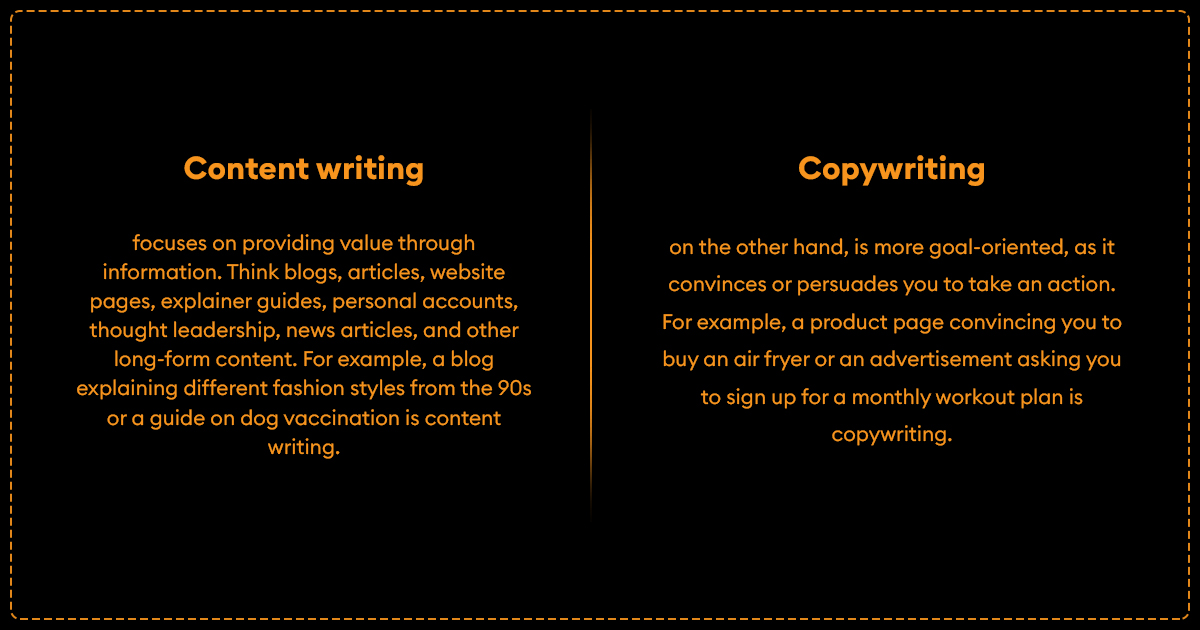
Comparison graphic highlighting the difference between content writing and copywriting, with side-by-side definitions explaining how content writing informs audiences while copywriting persuades them to take action.

Content writing educates and informs, while copywriting persuades and converts—understanding the difference is essential for modern brand communication.

In today’s digital landscape, however, the lines often overlap. Good content includes elements of copywriting, and effective copy often needs to provide value.

Why Modern Brands Need Copywriting

As digital media consumption has grown rapidly in recent years, content is everywhere. Whether you’re surfing social media on a smartphone, shopping on websites, listening to the radio, or watching a film on OTT, everyone has something to say. One brand wants you to buy their coffee, the other wants you to sign up for their monthly treat box for dogs, while a nonprofit wants you to donate money for a noble cause.

Person using a smartphone surrounded by floating social media icons, analytics dashboards, engagement metrics, and digital content elements, representing modern digital marketing and copywriting across online platforms.

Great copywriting helps brands cut through digital noise, capture attention, and inspire action across social media, websites, and online campaigns.

On top of that, attention spans are shorter than ever, which is why clarity and communication are everything. Without it, your message might not reach the intended audience or it might not drive the results required to meet your business goals. Thus, every modern brand needs copywriting, and here’s why:

  • Ensures Clear Communication

More than anything, copywriting is about clear communication. You say what you have to say in as few words as possible and without complex phrases. Good copywriting simplifies ideas and communicates them in a way that is easy to understand and relate to. No matter how strong your product or service, if your messaging isn’t clear, your audience won’t understand its value. For instance, Blinkit’s ad hoarding with ‘Apple Koi Bhi Ho, Delivered in 10 Minutes’ with imagery of an apple and an iPhone simply explains that they offer a wide range of products while highlighting their quick 10-minute delivery model.

A large roadside billboard against a blue sky displays a wedding fashion advertisement. Two men wearing traditional Indian wedding outfits stand on the right side of the hoarding, while the headline “Shaadi wala look. Karan Main wala touch” appears prominently on a brown background. The ad demonstrates how concise copy and strong visuals work together to communicate a brand message instantly.

A weddingwear billboard showcasing how clear, memorable copywriting and relevant visuals can quickly communicate a brand’s value proposition.

  • Captures and Holds Attention

With endless content competing for attention, it takes mere seconds for your audience to engage or move on. By bringing psychology, strategy, and creativity together, copywriting is designed to not only capture attention but also retain it. For instance, a coffee brand targeting vegans advertises itself as ‘Ethically Sourced Coffee Blended with Oat Milk.’ Here, both USPs are attention-grabbing, as vegans believe in ethical sourcing of food items and consume only plant-based milk.

  • It Drives Action

As we mentioned earlier, copywriting is also referred to as persuasive writing, meaning it convinces you to take a desired action. Whether it’s a call-to-action on a website or a caption on a social media post, effective copy encourages your audience to take the next step. For instance, a carousel post on Instagram with the title ‘Top 10 Benefits of Using a Retinol Serum’ ends with a CTA reading ‘The Only Retinol Serum You Need. Buy Now.’ Here, the brand engages with the audience by listing out retinol benefits and drives them to order their serum with a simple call-to-action.

A creative illustration featuring the word “BRAND” in large white letters against an orange background, surrounded by icons and keywords such as marketing, SEO, strategy, teamwork, planning, technology, customers, and innovation. The graphic represents the role of branding, communication, and copywriting in shaping a company's identity and driving audience engagement.

A branding illustration highlighting how strategic copywriting helps businesses establish a distinct voice, strengthen brand identity, and encourage customer action.

Key Elements of Effective Copywriting
A close-up image of the word “Copywriting” typed on paper using a vintage typewriter. The visual symbolizes the craft of writing persuasive and impactful content for marketing, branding, and communication.

The foundation of effective copywriting lies in combining clarity, persuasion, and creativity to communicate messages that engage audiences and drive results.

  • Clarity Over Complexity: The first rule of copywriting is to keep the text simple and clear. The more complicated the language, the less effective the messaging. It is best to steer clear of complex words, industry jargon, and long sentences, as doing so can confuse your audience and dilute your message.
  • Audience Understanding: Good copywriting focuses on the customer, particularly their needs, challenges, and expectations. The copy should speak to them instead of focusing on the brand’s perspective. Be it an ad or a product tagline, it should resonate with the customer to drive action.
  • Strong Headlines: A copy should grab the reader’s attention, and the easiest way to do so is through engaging headlines. It should be clear and direct while highlighting a benefit or outcome that encourages the reader to continue reading. The headline should not be too vague or generic. For instance, ‘Learn About Our Services’ is generic while ‘Build a Brand That Lasts’ is more specific and benefit-driven.
  • Clear Value Proposition: Customers don’t just want to know about your product or service, they want to know how it helps them. For example, instead of saying, ‘Our app has a real-time tracking system,’ go with a value-led copy like, ‘Track your deliveries in real time and never miss an update.’
  • Consistent Tone of Voice: Consistency builds familiarity, which is why it is crucial to have a consistent tone of voice. Switching between conversational, friendly, or overly formal tones can confuse your audience and weaken brand recall. The tone should feel natural, reflect your brand personality, and stay consistent across platforms.
  • Focused Messaging: Another core aspect of copywriting is focused messaging. Saying too much at once can become overwhelming for the audience, making the intended message ineffective. It should be clear, impactful, and as less wordy as possible.
  • Strong Call-to-Action (CTA): The last yet the most important element is a strong call-to-action (CTA). Even a well-written copy can fall short if it doesn’t guide the reader on their next step. For instance, ‘Start Your Free Trial Today’ is a stronger CTA compared to ‘Click Here’ as it is specific, action-oriented, and gives the user a clear action.
A wooden signboard along a mountain trail displays the motivational message “Dream Big, Set Goals, Take Action,” with the words “Take Action” highlighted. The image symbolizes the importance of clear and compelling calls-to-action in guiding audience behavior.
A strong call-to-action transforms interest into action by clearly directing audiences toward the next step.
Summing Up

Copywriting plays a key role in how your brand tells its story and how it is perceived by the audience. It is not just about selling, but about connecting, building trust, and being relatable. Whether it’s a product tagline or a campaign slogan, good copywriting ensures communication with purpose.

When done right, it helps simplify your message, capture attention, and guide your audience towards action. It turns everyday interactions into meaningful touchpoints. Because while visuals may draw people in, it’s the words that often convince them to stay, engage, and choose you!

Leave a Reply

Your email address will not be published. Required fields are marked *

Fill out this field
Fill out this field
Please enter a valid email address.
You need to agree with the terms to proceed

keyboard_arrow_up